What Happens When Every Advertising Channel Is Asked to Do the Same Job?
Published by Assured Advertising | 07 October 2026 | Blog
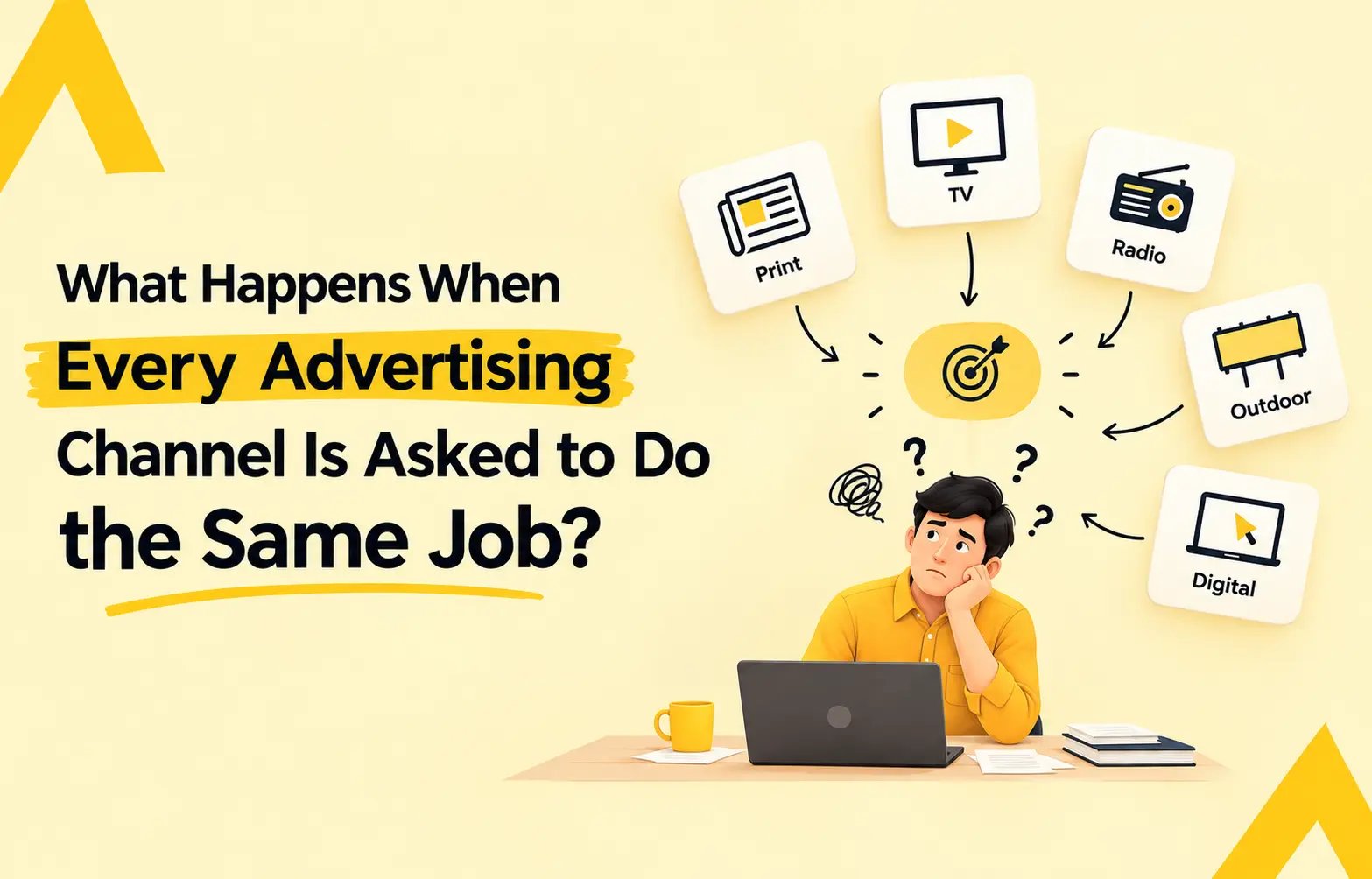
A brand can put the same campaign on TV,print, ooh, radio and digital and call it integrated. Fine. But if every channel is being asked to do the same thing, the plan may simply be paying repeatedly for one function without proving that the extra exposure beats the alternative use of the budget.
Every rupee put into one channel is a rupee that cannot go somewhere else. Good media planning asks what each opportunity is supposed to achieve, then compares that contribution with what the same budget could achieve elsewhere.
A channel does not deserve money because it can work. It deserves money when its contribution is more useful than the alternative.
The Same Budget Can Need Different Media Jobs
Take a real-estate developer launching a project in Mumbai.
If the objective is broad city-wide awareness, broader-reach opportunities can receive greater priority because the campaign needs wider exposure.
Now change the objective to qualified interest within selected Mumbai catchments. Some budget can move toward geographically relevant OOH, supported by digital for active property research.
Same budget. Different job.
Money used to maximise broad exposure is no longer available for concentrated visibility around a priority catchment. The media mix should follow the objective, not a fixed list of channels that appears because “we've always done it this way.”
Overlap, Duplication and Reinforcement Are Not the Same Thing
Overlap means the same audience encounters more than one channel. Nothing inherently wrong with that.
Duplication happens when multiple investments perform substantially the same strategic function without adding a sufficiently useful contribution to the campaign objective to justify the budget.
Reinforcement is different. OOH can build physical visibility while digital supports someone already researching the category. The audiences may overlap. The jobs can differ.
That distinction changes allocation. Overlap can be sensible, duplication can weaken spend, and reinforcement can justify multiple channels.
If another channel can make a more useful incremental contribution with the same rupee, why spend it here?.
More Reach Is Not Automatically More Useful
But more reach does not automatically mean a better media decision. For a brand targeting an entire city, broad reach may deserve more budget. For a defined Mumbai catchment, geographic relevance can matter more than total audience size.
The question is whether additional reach contributes more to the objective than the alternative use of the same budget. That is opportunity cost, whether the plan acknowledges it or not.
Media Planning Is Really a Budget Trade-Off
Nielsen's 2024 global cross-media analysis found that only 36% of media channels performed above average for both sales and awareness. Nielsen's analysis also examines cross-media measurement, including deduplicated reach and frequency. This is a global finding, not an India-specific performance benchmark.
The strategic inference is not that Nielsen proves one allocation will outperform another. It is that media planning should compare each opportunity's role and incremental contribution against the alternatives competing for the same budget.
Give Every Channel a Clear Role. Then Make the Budget Earn Its Place.
Role: What job is this opportunity supposed to perform?
Investment: What budget does that role justify, and what are we giving up by putting the money here?
Measurement: What evidence tells us whether the opportunity delivered against that job?
If OOH is being used for geographic visibility, evaluate placement quality, audience relevance and whether achieved frequency is appropriate to the campaign objective. If digital is being used for response, use response-oriented measures.
These measures indicate delivery against the assigned role. They do not establish that media exposure caused a business outcome. Creative, pricing, distribution, competition and timing can influence the result too.
When Another Channel Does Not Earn the Next Rupee
Adding another channel because “we should be everywhere” is not a strategy. It is FOMO with a media budget.
An additional channel deserves investment when it brings a distinct role, useful incremental contribution and a stronger case than the alternative use of that budget. If it repeats an existing function, the case gets weaker.
This is the logic behind strategic media visibility: audience, context, role, allocation and measurement need to be considered together. It is the approach Assured Advertising applies to media investment decisions.
When every channel is asked to do the same job, the media plan stops looking like a deliberate allocation of scarce budget and starts looking like a shopping list. More channels. More placements. Not necessarily more strategic value.
The plan starts optimising for presence instead of contribution. Budget discipline gets weaker.
A channel does not earn the next rupee because it can work. It earns it when its incremental contribution is more useful than the alternative use of that rupee.
FAQs
1. How should a brand allocate media budget across channels?
Start with the campaign objective, define the role each channel can perform, compare its incremental contribution with the alternative use of the same budget and decide how that contribution will be measured.
2. What is the difference between media planning and media mix?
Media planning is the broader process of deciding audiences, channels, timing, budget, roles and measurement. The media mix is the resulting combination of channels and how investment is distributed among them.
3. Does a higher-reach channel always deserve more budget?
No. Reach should be considered alongside the campaign objective, audience relevance, context, geography and the specific role the opportunity is expected to perform. A lower-reach opportunity can deserve greater investment when its contribution is more relevant to the objective.
4. How can a brand tell if two media channels are duplicating each other?
Compare the strategic roles assigned to both channels. If they reach similar audiences and perform substantially the same function without adding a sufficiently useful contribution, the investment may be duplicative rather than complementary.